How Often Should You Calibrate Diagnostic Devices
HOW OFTEN SHOULD YOU CALIBRATE DIAGNOSTIC DEVICES: A COMPREHENSIVE GUIDE
Abstract: Medical diagnostic device calibration is a critical process that ensures accuracy, patient safety, and regulatory compliance in healthcare settings. This comprehensive guide examines calibration frequencies, regulatory requirements, and best practices for maintaining optimal performance of diagnostic equipment across various medical specialties.
Introduction
Medical equipment calibration is the process of adjusting and verifying the accuracy and reliability of medical devices to ensure that their measurements align with established standards. This practice is not merely a technical requirement—it represents a fundamental aspect of patient safety and diagnostic accuracy that directly impacts healthcare outcomes.Figure 1: Professional medical equipment calibration process ensuring device accuracy and patient safety
The accuracy of diagnostic devices has profound implications for patient care. Inaccurate readings or performance discrepancies can lead to misdiagnoses, inappropriate treatment plans, and potential harm to patients. Furthermore, calibration ensures compliance with stringent regulations from bodies such as the U.S. Food and Drug Administration (FDA) and the International Organization for Standardization (ISO).
THE CRITICAL IMPORTANCE OF DIAGNOSTIC DEVICE CALIBRATION
Healthcare facilities depend on precise diagnostic measurements for clinical decision-making. When diagnostic devices drift from their specified accuracy parameters, the consequences can be severe. For instance, blood pressure monitors that read incorrectly may lead to over-medication or under-treatment of hypertensive patients. Similarly, inaccurate glucose meters can result in improper insulin dosing for diabetic patients.
Regular calibration serves multiple critical functions in healthcare environments:
- Ensures measurement accuracy within specified tolerance limits
- Maintains compliance with regulatory standards and accreditation requirements
- Protects patients from diagnostic errors and treatment complications
- Preserves institutional reputation and reduces liability risks
- Optimizes equipment lifespan through preventive maintenance integration
What Calibration Involves: Calibration, Verification and Maintenance
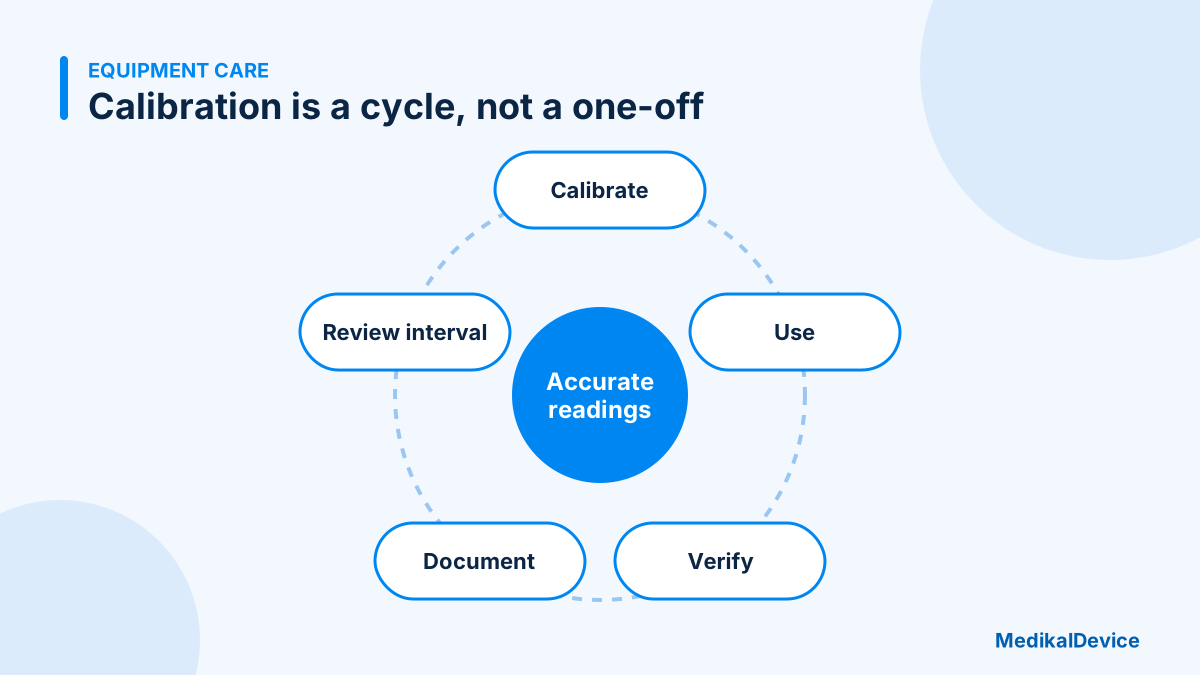
The terms calibration, verification and maintenance are often used interchangeably, but they describe different activities. Confusing them is a common reason why a facility believes its equipment is calibrated when it is not.
- Calibration compares a device's readings with a reference standard of known accuracy and records the difference. If the error is outside the allowed tolerance, the device is adjusted and checked again.
- Verification (or a performance check) confirms that a device still reads within tolerance, without necessarily adjusting it. Daily quality control on a laboratory analyzer and a pre-use check on a glucose meter are forms of verification.
- Preventive maintenance covers cleaning, inspection, part replacement and electrical safety testing. A device can be well maintained and still read inaccurately if it has not been calibrated.
A valid calibration depends on traceability: the reference standards used must themselves have been calibrated in an unbroken chain back to national or international standards, such as those maintained by the National Institute of Standards and Technology (NIST) in the United States. When calibration is outsourced, look for a laboratory accredited to ISO/IEC 17025, the international standard for the competence of testing and calibration laboratories, with the relevant measurements listed in its scope of accreditation.
The type of reference used depends on what the device measures: electrical quantities (voltage, current, frequency, ECG signal amplitude), pressure and flow, temperature, mass, or optical properties such as wavelength and light intensity. Many devices measure several quantities and need each one checked.
REGULATORY FRAMEWORK AND STANDARDS TO CALIBRATE MEDICAL DEVICES
FDA REQUIREMENTS
The Food and Drug Administration sets calibration requirements for medical device manufacturers under 21 CFR Part 820 (the Quality System Regulation, amended in 2026 as the Quality Management System Regulation, which incorporates ISO 13485 by reference). These rules apply to manufacturers; healthcare facilities are generally guided by manufacturer instructions, accreditation bodies, and CLIA for laboratories. Key requirements for manufacturers include:
- Calibration at specified intervals according to established procedures
- Documentation of all calibration activities and results
- Establishment of acceptable limits and corrective actions for deviations
- Traceability to national and international standards
ISO 13485:2016 STANDARDS
ISO 13485:2016 specifies requirements for quality management systems in medical device manufacturing and related services. Clause 7.6 specifically addresses the control of monitoring and measuring equipment, requiring organizations to calibrate or verify measuring equipment at specified intervals or prior to use against measurement standards traceable to international or national measurement standards.
Figure 2: Modern biomedical calibration systems ensuring compliance with international standards
CALIBRATION FREQUENCY CLASSIFICATIONS
The frequency of calibration varies significantly based on multiple factors including device type, usage patterns, environmental conditions, and regulatory requirements. The intervals below are typical examples only; always follow the manufacturer's instructions for use, your accreditation body, and applicable regulations.PRE-USE CALIBRATION (DAILY)
Certain critical diagnostic devices commonly receive performance checks before each use or at the beginning of each operational day. This category typically includes:- Point-of-care glucose meters
- Portable blood gas analyzers
- Emergency defibrillators
- Portable ultrasound devices used in critical care
- Temperature monitoring devices for medication storage
Weekly Calibration
Weekly calibration intervals are commonly applied to equipment that experiences moderate to heavy usage but maintains relatively stable performance characteristics:- Laboratory analytical balances
- Precision weighing scales in pharmaceutical preparation
- Centrifuges used for diagnostic testing
- Environmental monitoring equipment in sterile processing areas
Monthly Calibration
Monthly calibration schedules are appropriate for equipment that demonstrates good stability but requires regular verification due to its critical role in patient care:- Automated blood pressure monitors
- Pulse oximeters
- Thermometers used in patient care areas
- Refrigerator and freezer temperature monitoring systems
- Infusion pump accuracy verification
Figure 3: Advanced medical equipment calibration laboratory with precision instruments
Quarterly Calibration
Quarterly calibration intervals are suitable for stable equipment that operates in controlled environments:- Laboratory pH meters
- Conductivity meters
- Autoclave temperature and pressure verification
- HVAC system monitoring equipment
- Non-critical temperature monitoring devices
Semi-Annual Calibration
Semi-annual calibration (every six months) is appropriate for equipment with demonstrated long-term stability:- Laboratory spectrophotometers
- Microscope calibration standards
- Environmental chambers
- Water quality monitoring equipment
Annual Calibration
Annual calibration represents the most common interval for medical equipment and is often the minimum requirement for maintaining warranties and regulatory compliance:- MRI scanners
- CT scanners
- X-ray equipment
- Ultrasound imaging systems
- Laboratory chemistry analyzers
- Hematology analyzers
- Electrophysiology equipment
- Patient monitoring systems
Device-Specific Calibration Requirements
Critical Care Equipment
Equipment used in intensive care units and emergency departments typically requires more frequent calibration due to their critical role in patient monitoring and life support. Ventilators, for example, typically receive pre-use operational checks and periodic preventive maintenance and calibration on the manufacturer's recommended schedule.Laboratory Diagnostic Equipment
Laboratory equipment follows protocols based on the Clinical Laboratory Improvement Amendments (CLIA), which require calibration verification at least every six months and quality control at defined frequencies. Typical quality control frequencies are shown below:
| Equipment Type | Typical QC Frequency | Verification Requirements |
|---|---|---|
| Chemistry Analyzers | Daily/Per Shift | Multi-level controls, linearity checks |
| Hematology Analyzers | Daily | Control samples, carry-over checks |
| Coagulation Analyzers | Daily | Control plasmas, temperature verification |
| Blood Gas Analyzers | Daily/Per Shift | Multi-level gas standards |
| Urinalysis Systems | Daily | Control samples, reagent checks |
Imaging Equipment
Medical imaging equipment requires specialized quality assurance protocols that address both image quality and radiation safety considerations. Typical schedules (which vary by state rules, accreditation programs, and manufacturer) include:
- X-ray Systems: Annual comprehensive calibration with quarterly quality assurance checks
- CT Scanners: Annual calibration with weekly constancy checks
- MRI Systems: Annual comprehensive calibration with monthly quality assurance protocols
- Ultrasound Systems: Annual calibration with periodic beam profile verification
- Nuclear Medicine Equipment: Daily constancy checks with comprehensive annual calibration
Figure 4: State-of-the-art medical diagnostics equipment undergoing precision calibration procedures
Key Calibration Parameters by Device Type
Knowing how often to calibrate is only half the question; the other half is what to check. The table below lists parameters commonly verified during calibration or performance testing. The manufacturer's service manual defines the exact tests, test equipment and tolerances for each model.
| Device type | Parameters typically checked |
|---|---|
| Multiparameter patient monitors | ECG amplitude and heart rate, non-invasive blood pressure accuracy, temperature, SpO2 using a simulator, alarm function |
| Non-invasive blood pressure monitors | Pressure transducer accuracy against a reference manometer, cuff leak, overpressure protection |
| Infusion pumps | Flow rate and volume accuracy, occlusion pressure detection, air-in-line and other alarms |
| Ventilators | Delivered volume and flow, airway pressure measurement, oxygen concentration, alarms |
| Defibrillators | Delivered energy at several settings, charge time, synchronized mode, ECG monitoring |
| Thermometers and temperature monitoring | Readings at more than one point against a traceable reference thermometer |
| Laboratory analyzers | Calibration for each analyte, calibration verification across the reportable range, quality control results |
| Imaging equipment | Radiation output, image quality and dose for X-ray and CT; field homogeneity and image quality for MRI, usually performed or overseen by a qualified medical physicist |
FACTORS INFLUENCING CALIBRATION FREQUENCY
Usage Intensity
Equipment subjected to heavy daily use requires more frequent calibration than devices used occasionally. High-throughput laboratory analyzers, for example, may require daily calibration checks compared to research equipment used weekly.Environmental Conditions
Harsh environmental conditions, temperature fluctuations, humidity variations, and vibration exposure can accelerate instrument drift, necessitating more frequent calibration intervals.Criticality of Measurements
Devices used for life-critical measurements or those directly affecting patient treatment decisions require more stringent calibration schedules. Point-of-care devices used in emergency situations exemplify this category.Historical Performance
Equipment with a history of stability may warrant extended calibration intervals, while devices showing frequent drift require more frequent attention. Calibration records provide valuable data for optimizing intervals.Manufacturer Recommendations
Device manufacturers provide calibration interval recommendations in their instructions for use. These recommendations serve as the baseline for establishing facility-specific protocols.Best Practices for Calibration Program Implementation
Documentation and Record Keeping
Comprehensive documentation is essential for regulatory compliance and quality assurance. Calibration records must include:- Equipment identification and serial numbers
- Calibration date and next due date
- Calibration procedure reference
- Standards used and their certification status
- Actual measurements and acceptable limits
- Technician identification and qualifications
- Corrective actions taken for out-of-tolerance conditions
Calibration Status Identification
All calibrated equipment must display clear identification of calibration status, typically through:- Calibration labels showing dates and due dates
- Color-coded status indicators
- Electronic tracking systems with visual displays
- Segregation of out-of-service equipment
Figure 5: The scientific precision required in medical equipment calibration for diagnostic accuracy
Staff Training and Competency
Calibration personnel must receive comprehensive training covering:- Calibration principles and techniques
- Specific equipment operation and calibration procedures
- Safety protocols and contamination control
- Documentation requirements and record keeping
- Troubleshooting and corrective action procedures
- Regulatory requirements and quality standards
Preventive Maintenance Integration
Calibration programs should integrate with preventive maintenance schedules to optimize equipment performance and reduce downtime. This integration includes:- Coordinating calibration with routine maintenance activities
- Performing calibration after significant repairs or component replacement
- Monitoring equipment performance trends
- Planning equipment replacement based on calibration history
Handling Out-of-Tolerance Results and Common Program Gaps
When a Device Fails Calibration
Finding a device out of tolerance is not only a repair issue. Any results produced since the last successful calibration may have been affected. ISO 13485 requires manufacturers to assess the validity of previous measurement results in this situation, and the same reasoning is good practice for healthcare facilities. A typical response is:
- Remove the device from service and label it clearly so it is not used by mistake.
- Record the as-found readings before any adjustment, so the size of the error is documented.
- Assess the impact: estimate how long the device may have been inaccurate, which patients or results could be affected, and whether the error was large enough to matter clinically.
- Inform the responsible clinical or laboratory leaders so they can decide whether results need to be reviewed, repeated or corrected.
- Investigate the cause, such as wear, damage, environmental conditions, or a calibration interval that is too long.
- Repair or adjust the device, recalibrate it, and record the as-left readings before returning it to service.
- Review the calibration interval and shorten it if the drift suggests it is needed. Report the event through your incident reporting system and, where a device problem may have contributed to patient harm, consider whether an FDA MedWatch report is required.
Common Gaps in Calibration Programs
- Treating servicing as calibration: maintenance visits that do not include traceable measurements against reference standards.
- Incomplete inventory: portable and low-cost devices such as thermometers, glucose meters and scales missing from the equipment list, so they are never scheduled.
- Overdue work: devices that cannot be located when calibration is due, with no escalation process.
- Weak records: certificates without as-found and as-left values, reference standard details or measurement uncertainty.
- Unchecked vendors: outside service providers whose accreditation scope and procedures have not been reviewed.
- No feedback loop: calibration results are filed but never analyzed to adjust intervals or plan replacements.
Accreditation surveyors, including The Joint Commission for hospitals and the College of American Pathologists for laboratories, routinely review equipment inventories and maintenance and calibration records. Structured tools such as Failure Mode and Effects Analysis (FMEA) can help prioritize which devices and failure modes deserve the most attention.
Technology Solutions for Calibration Management
Computerized Maintenance Management Systems (CMMS)
Modern healthcare facilities increasingly rely on CMMS solutions to manage calibration programs effectively. These systems provide:- Automated scheduling and reminder notifications
- Comprehensive equipment databases and histories
- Electronic work order generation and tracking
- Regulatory compliance reporting
- Integration with inventory and procurement systems
Mobile Calibration Solutions
Portable calibration equipment and mobile applications enable efficient on-site calibration services, particularly beneficial for:- Large healthcare systems with multiple locations
- Remote or satellite facilities
- Emergency calibration requirements
- Point-of-care device management
Quality Assurance and Continuous Improvement
Performance Monitoring
Effective calibration programs incorporate continuous monitoring of equipment performance through:- Statistical analysis of calibration results
- Trend analysis for predictive maintenance
- Correlation of calibration data with clinical outcomes
- Benchmarking against industry standards
Risk-Based Calibration Strategies
Modern calibration programs increasingly adopt risk-based approaches that consider:- Patient safety impact of measurement errors
- Clinical decision-making criticality
- Regulatory compliance requirements
- Cost-benefit analysis of calibration intervals
Emerging Trends and Future Considerations
Predictive Calibration
Advanced analytics and artificial intelligence are enabling predictive calibration approaches that optimize intervals based on real-time performance data and environmental conditions.Remote Calibration Capabilities
Internet of Things (IoT) connectivity and remote diagnostics are facilitating remote calibration verification and adjustment for certain types of equipment, reducing facility disruption and improving efficiency.Regulatory Evolution
Regulatory bodies continue to evolve calibration requirements, with increasing emphasis on risk-based approaches and digital documentation systems.Conclusion
Diagnostic device calibration represents a critical component of healthcare quality assurance that directly impacts patient safety and care outcomes. The frequency of calibration must be carefully determined based on multiple factors including device criticality, usage patterns, environmental conditions, and regulatory requirements.Healthcare facilities must develop comprehensive calibration programs that incorporate appropriate intervals for different device categories, from daily pre-use checks for critical point-of-care devices to annual comprehensive calibrations for major imaging equipment. Success depends on proper documentation, staff training, technology integration, and continuous improvement processes.
As healthcare technology continues to advance, calibration programs must evolve to incorporate predictive maintenance strategies, remote monitoring capabilities, and risk-based optimization approaches. The investment in robust calibration programs ultimately serves the fundamental goal of providing safe, effective patient care through accurate diagnostic measurements.
MEDICAL CLOUD AI IN USA
RESULTS OF YOUR AUOCLAVE ON YOUR MOBILE PHONE